The most common complaint from health system executives about their wound center programs is not patient outcomes or physician performance. It is information.
Specifically, it is the absence of it. When leadership wants to know how their wound care network is performing, the answer usually involves waiting for a report that a site prepared, submitted through a management company, and formatted in a way that shows what that management company wants to show.
That is not a healthcare network portal. That is a reporting lag with a dashboard skin over it.
This article covers what hospital networks actually need from a wound care management system, why general healthcare management systems cannot deliver it, and what the difference looks like in the data.
General healthcare management systems are built for breadth. They are designed to handle patient records, scheduling, billing workflows, and reporting across a hospital's full range of services. Wound care is one checkbox in a long list. That breadth creates specific gaps when a health system tries to use a general system to manage a wound care network.
Wound care documentation requires data fields that general EMRs and healthcare management systems were not designed to capture at the specificity CMS and LCD requirements now demand. A general system can record that a wound care visit occurred. It typically cannot capture wound measurement progression in a format that supports LCD compliance documentation, track skin substitute application criteria against current coverage requirements, log HBOT treatment details at the visit level with the specificity audit reviewers require, or flag documentation gaps before a claim is submitted rather than after a denial is received.
When a wound care program is documented through a general system, the clinical data exists but the compliance-ready structure does not. The result is claims that are technically supported by a clinical record but documented in a format that does not survive audit scrutiny.
Standard healthcare management system reporting is built around scheduled reporting cycles. Monthly summaries. Quarterly reviews. Annual performance assessments. For wound care network management, that cycle is too slow. A volume decline that starts in week one of a month and is visible in the monthly report in week five has already had four weeks to compound. A documentation inconsistency that appears in a quarterly review has been producing potentially non-compliant claims for three months.
The financial exposure from lagging data is not theoretical. It is the difference between catching a billing pattern in week two and catching it in an audit 18 months later.
In most hospital networks, wound care clinical data, billing data, and compliance data live in three separate systems with three separate reporting structures. Getting a complete picture of how a wound center is performing requires pulling data from all three and reconciling them manually. This is how revenue leakage becomes invisible. A clinical record that supports a higher-value billing code, submitted under a lower-value code because the documentation did not surface the supporting detail, shows up as a paid claim in the billing system. It does not show up anywhere as uncaptured revenue.

A wound care-specific clinical operations platform is not a replacement for your hospital's EMR. It is the operational layer that sits between your clinical workflow and your leadership reporting, handling what a general system cannot: wound care-specific documentation, compliance tracking, and network-level performance benchmarking.
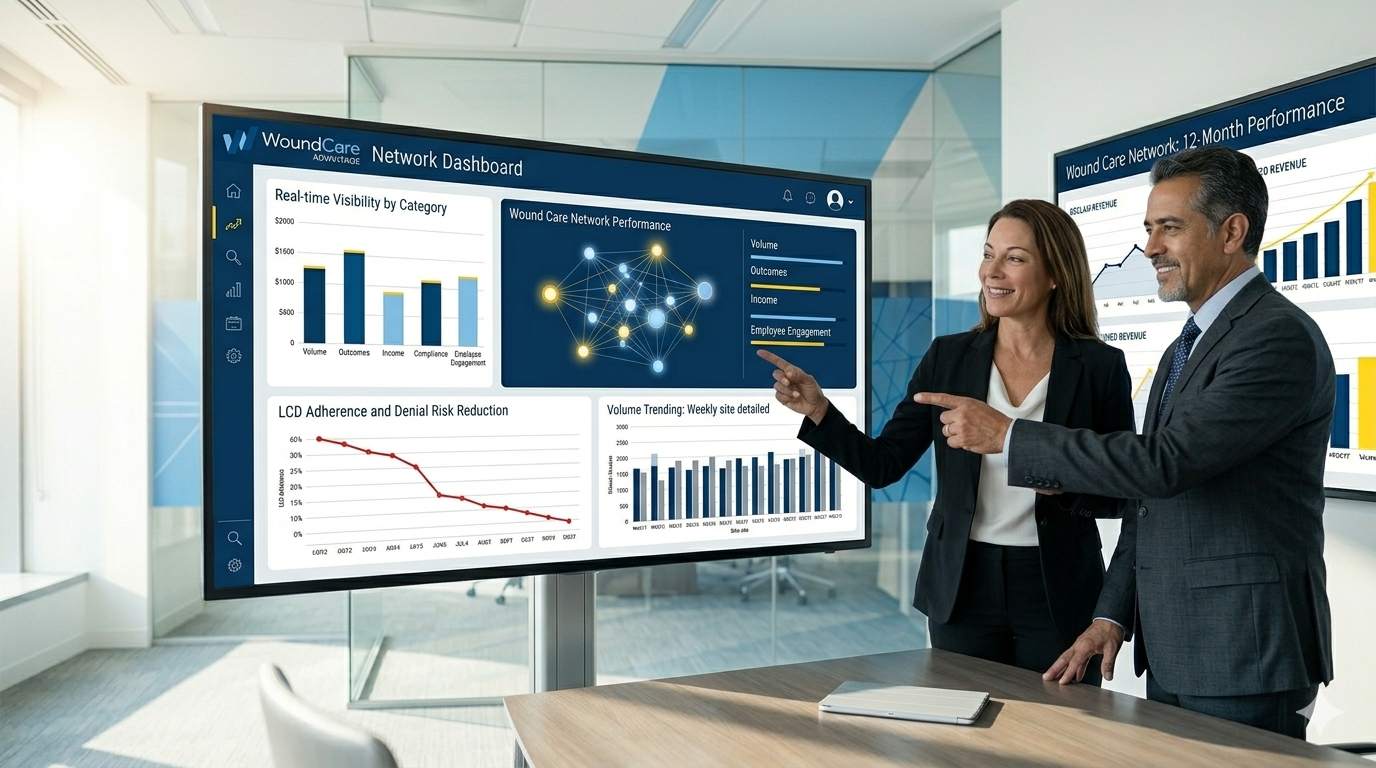
WCA's network management framework tracks five data categories simultaneously across every wound care site: Volume, Outcomes, Income, Compliance, and Employee Engagement. These are not categories that health system leadership sees in a monthly report. They update continuously as clinical and billing activity occurs at each site.
Patient referral patterns, appointment completion rates, and new patient intake by site. A volume decline at one center is visible in the week it begins, not at month end.
Healing rates, wound closure timelines, and complication rates benchmarked against the network average. A site underperforming clinically surfaces before it becomes a quality concern at the board level.
Billing cycle performance, claim status, denial rates, and revenue per visit across every center. This is where networks discover the gap between what should be billed and what is actually collected.
Documentation completion rates, LCD adherence, and audit-readiness scores in real time. A documentation gap identified today costs nothing to fix. The same gap found in an audit costs significantly more.
Clinical team retention indicators. High turnover in wound care directly affects volume and clinical continuity. Seeing it as a data point gives network leadership time to respond before it becomes a staffing crisis.
The most valuable function of a wound care-specific clinical operations platform is what happens before a claim leaves the building. Every wound care visit generates a documentation record. In a wound care-specific system, that record is reviewed against LCD requirements and billing standards before submission, not after a denial. Documentation gaps are flagged to the clinical team for correction while the visit is still fresh.
This is the mechanism that produces WCA's average 89% reduction in denial risk per center. It is not a billing recovery service after claims are denied. It is a documentation quality process that prevents the conditions that produce denials in the first place.
One dashboard showing network-wide averages is not enough. A health system needs to know not just how the network is performing but which sites are driving the average up and which are pulling it down. WCA's healthcare network portal surfaces both levels simultaneously. Network leadership sees the aggregate performance picture. They can also drill to any individual site to see its specific volume trend, documentation rate, compliance score, and financial performance against the network benchmark.
This is the difference between knowing the network has a denial problem and knowing that three specific sites are generating 80% of the denials, all three from the same documentation gap, which can be corrected with a single targeted intervention rather than a network-wide process overhaul.
USC Verdugo Hills Hospital had low volume and low revenue when WCA took over operations. The information problem was part of the clinical problem. Without visibility into what was happening at the program level, leadership could not identify where volume was being lost, where billing was failing, or where clinical documentation was inconsistent. After WCA implemented its operations model and real-time reporting infrastructure, USC Verdugo Hills saw a 62% volume increase and a 100.5% revenue increase.
The HAPI prevention program built alongside the wound care program demonstrates the same principle applied to clinical outcomes. By tracking hospital-acquired pressure injury rates continuously rather than periodically, the program achieved a 56% reduction in HAPI incidences in its first year and a 95% reduction over eight years. CNO Theresa Murphy credited the evidence-based tracking and WCA partnership with producing results the hospital had not achieved under previous approaches.
The data did not create those results. Clinical expertise and operations support created them. But without the data infrastructure to direct that expertise to the right problems at the right sites at the right time, the improvements would have been slower and less targeted.
If your wound care network leadership cannot answer the following three questions without making a phone call or waiting for a report, your management system has a gap.
This is not an advanced analytics question. It is an operational minimum for managing a multi-site wound care program. A wound care-specific management system should surface this without being asked.
Not last month. This week. If the answer requires a report request or a management company communication, the visibility gap is real and it is producing exposure every day it persists.
Volume declines in wound care do not reverse themselves. They compound. Catching a trend in week two versus week eight is the difference between a referral relationship conversation and a program recovery effort.
WCA's network assessment answers all three of those questions for your program on day one. What you see is typically the clearest case for what needs to change. Begin at thewca.com/contact

No. Luvo works alongside your existing EMR as a wound care-specific clinical operations layer. Your EMR handles patient records and hospital-level reporting. Luvo handles wound care-specific operational data: documentation compliance review, denial tracking, outcome benchmarking, and network-level performance reporting. The two systems operate in parallel, not in competition.
Core operational metrics update in real time as documentation and billing activity occurs at each site. There is no waiting period for site-level data to reach network leadership. Summary reports compile daily. The dashboard reflects current program status, not last month's status.
Yes. WCA's model gives the health system direct access to its own program data. You can query volume, outcomes, compliance, and financial performance independently at any time. The data belongs to your hospital, not to WCA.
The compliance review process checks documentation against current LCD requirements for skin substitute applications, HBOT treatment documentation, wound measurement standards, and clinical necessity criteria. When a documentation record does not meet current requirements, the system flags it before the claim is submitted. When LCD requirements update, the flagging criteria update across all sites simultaneously.